
Luo vs Lovable
Pick Lovable to generate a deployable web app — React frontend, Supabase database, its own URL — that you ship to users. Pick Luo to build the workspace your team runs on — a custom user interface (UI), database, integrations with Gmail, Slack, and HubSpot, and automations built in — all from a conversation.
At a glance
| Feature | Lovable | Luo |
|---|---|---|
| What it is | AI app builder for shipping products to end-users | A workspace that builds your software and runs work for you (Company OS) |
| Who uses the output | End-users or customers, via a public URL | Your team, in a shared browser-based workspace |
| Output | A deployable web app with logins, user management, and its own domain | Custom UI, database, automations, and integrations — all running for your team |
| Database | Supabase (a hosted PostgreSQL database), set up per project | Built-in, tables set up from your description |
| Integrations | Connections you write into the app yourself | Gmail, Slack, Linear, HubSpot, Google Workspace, and 40+ more — built in |
| Automations and scheduled tasks | Not built in — logic you write into the app | Built in: schedules and triggers from the tools you connect |
| Knowledge base | Not part of the product | Built in: docs, notes, and files linked to records your automations touch |
| Team model | You build a product; others use it as customers | One teammate builds a workspace; others enroll as team members |
| Code export | Yes — clean React + Supabase to GitHub | No — Luo runs everything for you |
| Best for | Founders and teams building a product to ship to users | Teams building the internal tools they run on every day |
Products you ship vs. workspaces your team runs on
Your ops lead wants a place to track incoming demo requests — who owns each one, the Q&A history, next steps. In Lovable, that's a product: set up logins, connect Supabase, deploy the app, send the team a link. In Luo, it's a conversation: describe the tracker, and the team is using it in minutes with Gmail and calendar already connected.
That's the shape of the difference. Lovable builds products — things with their own URL and user accounts, shipped to people outside the company. Luo builds internal workspaces — the trackers, pipelines, briefings, and dashboards your team runs on every day, connected to the tools they already use.
Lovable gives you the code. Luo runs everything for you. You describe the outcome either way — but what you get back, and who uses it, is different.
Lovable is for building products. Luo is for running the team.
When Lovable is the better choice. We'll say this plainly because it's true.
- You're building a product to ship. A software product, a consumer app, a marketplace — something with its own URL, user accounts, and a customer-facing interface. That's Lovable's lane.
- Your users are customers, not teammates. The output isn't for your team; it's for people outside the company who log in via their own accounts.
- You want to own the codebase. Lovable exports clean React + Supabase to GitHub. Luo runs everything for you; there's nothing to export.
- You need customer logins and subscription billing. Lovable apps are designed for this. Luo workspaces are team-only, behind your Luo account.
- You're validating a first version. Describe an idea, generate the app, put it in front of real users. Lovable is fast for this loop.

When Luo is the better choice. When the output is something your team opens, not users.
- The "users" are your team. The output isn't a product customers log into — it's a tracker, a briefing, or a pipeline that teammates open every morning.
- You need integrations with existing tools. Gmail, Slack, HubSpot, Linear — Luo has 40+ built in. In Lovable, you'd write those connections yourself.
- The workspace needs automations running in the background. Scheduled tasks, triggers from connected tools, integration events. Luo has these built in; Lovable doesn't.
- More than one person needs to run the workflow. One teammate builds it once in Luo; others enroll. The result is shared, not a link you send around.
- You want a knowledge base in the same place. Docs, notes, and files linked to the people and records your automations are touching — built into every Luo workspace.
What people build with Luo
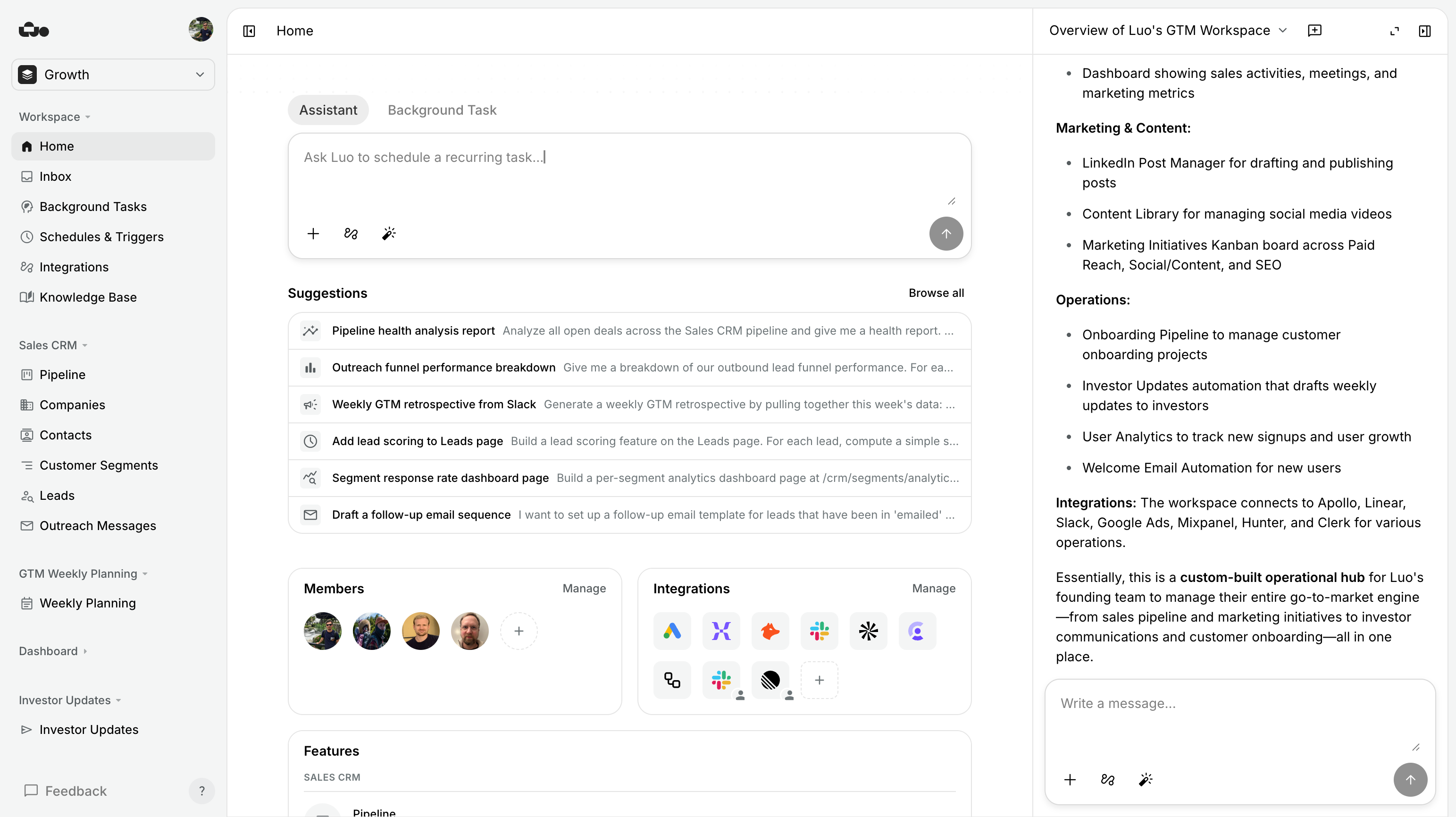
Each of these is one workspace — automation, custom UI, database, and integrations — generated from a conversation. None of them are products with user accounts; all of them are operational workspaces teams open instead of a spreadsheet.


%20--%3e%3csvg%20version='1.1'%20id='Livello_1'%20xmlns='http://www.w3.org/2000/svg'%20xmlns:xlink='http://www.w3.org/1999/xlink'%20x='0px'%20y='0px'%20viewBox='0%200%20200%20200'%20enable-background='new%200%200%20200%20200'%20xml:space='preserve'%3e%3cg%3e%3cg%20transform='translate(3.75%203.75)'%3e%3cpath%20fill='%23FFFFFF'%20d='M148.882,43.618l-47.368-5.263l-57.895,5.263L38.355,96.25l5.263,52.632l52.632,6.579l52.632-6.579%20l5.263-53.947L148.882,43.618z'/%3e%3cpath%20fill='%231A73E8'%20d='M65.211,125.276c-3.934-2.658-6.658-6.539-8.145-11.671l9.132-3.763c0.829,3.158,2.276,5.605,4.342,7.342%20c2.053,1.737,4.553,2.592,7.474,2.592c2.987,0,5.553-0.908,7.697-2.724s3.224-4.132,3.224-6.934c0-2.868-1.132-5.211-3.395-7.026%20s-5.105-2.724-8.5-2.724h-5.276v-9.039H76.5c2.921,0,5.382-0.789,7.382-2.368c2-1.579,3-3.737,3-6.487%20c0-2.447-0.895-4.395-2.684-5.855s-4.053-2.197-6.803-2.197c-2.684,0-4.816,0.711-6.395,2.145s-2.724,3.197-3.447,5.276%20l-9.039-3.763c1.197-3.395,3.395-6.395,6.618-8.987c3.224-2.592,7.342-3.895,12.342-3.895c3.697,0,7.026,0.711,9.974,2.145%20c2.947,1.434,5.263,3.421,6.934,5.947c1.671,2.539,2.5,5.382,2.5,8.539c0,3.224-0.776,5.947-2.329,8.184%20c-1.553,2.237-3.461,3.947-5.724,5.145v0.539c2.987,1.25,5.421,3.158,7.342,5.724c1.908,2.566,2.868,5.632,2.868,9.211%20s-0.908,6.776-2.724,9.579c-1.816,2.803-4.329,5.013-7.513,6.618c-3.197,1.605-6.789,2.421-10.776,2.421%20C73.408,129.263,69.145,127.934,65.211,125.276z'/%3e%3cpath%20fill='%231A73E8'%20d='M121.25,79.961l-9.974,7.25l-5.013-7.605l17.987-12.974h6.895v61.197h-9.895L121.25,79.961z'/%3e%3cpath%20fill='%23EA4335'%20d='M148.882,196.25l47.368-47.368l-23.684-10.526l-23.684,10.526l-10.526,23.684L148.882,196.25z'/%3e%3cpath%20fill='%2334A853'%20d='M33.092,172.566l10.526,23.684h105.263v-47.368H43.618L33.092,172.566z'/%3e%3cpath%20fill='%234285F4'%20d='M12.039-3.75C3.316-3.75-3.75,3.316-3.75,12.039v136.842l23.684,10.526l23.684-10.526V43.618h105.263%20l10.526-23.684L148.882-3.75H12.039z'/%3e%3cpath%20fill='%23188038'%20d='M-3.75,148.882v31.579c0,8.724,7.066,15.789,15.789,15.789h31.579v-47.368H-3.75z'/%3e%3cpath%20fill='%23FBBC04'%20d='M148.882,43.618v105.263h47.368V43.618l-23.684-10.526L148.882,43.618z'/%3e%3cpath%20fill='%231967D2'%20d='M196.25,43.618V12.039c0-8.724-7.066-15.789-15.789-15.789h-31.579v47.368H196.25z'/%3e%3c/g%3e%3c/g%3e%3c/svg%3e)


The two often go together
A lot of teams building with Lovable also use Luo. Lovable is where the product gets built. Luo is where the team that built it runs their day-to-day — the sales tracker, the marketing rollup, the customer onboarding flow.
They don't overlap. The product customers pay for lives in Lovable. The internal operations layer lives in Luo. The practical split: if the output needs a public URL and user accounts, Lovable; if it's something your team opens every morning, Luo.
Pricing
| Feature | Lovable | Luo |
|---|---|---|
| Free | Limited credits | Free plan — AI credits included, no credit card |
| Entry paid | Starter from ~$25/mo (credit-based) | Starter $20/mo — more AI credits included |
| Pricing model | Credits per AI interaction / code generation | Per workspace seat — AI usage included (while in beta) |
| Code export | Yes — React + Supabase to GitHub | Not applicable — Luo runs everything for you |
| Current rates | See lovable.dev for current pricing | See luo.app/pricing |
While Luo is in beta, AI usage is included on every plan — Free gets some credits, $20 gets more, $100 gets even more. There’s no per-run charge and no surprise bill when automations run often. Lovable’s credit model scales with how much you build and iterate, which is a different shape of cost entirely.
Frequently asked
Is Luo a Lovable alternative?
Not really — they cover different ground. Lovable builds products you ship to users: a software product, a consumer app, something with its own URL and user accounts. Luo builds the internal workspaces your team runs on: trackers, pipelines, briefings, and automations connected to the tools they already use. Most teams picking between them have different jobs to do.
Can Lovable build internal tools?
Yes, but without built-in integrations with Gmail, Slack, HubSpot, or Linear, no scheduled automations, and no shared knowledge base. You'd write all of that yourself. For a one-off internal app where you want to own the code, that's a reasonable trade-off. For the ongoing operational layer your team uses every day, Luo is built for that job.
Can Luo build a customer-facing product?
No. Luo builds internal workspaces for teams — there's no concept of a public URL, end-user accounts, or a product you sell. If the output needs to live on its own domain with customer logins and Stripe, Lovable is the right tool.
Do I need to choose between them?
Many teams use both: Lovable to build the product, Luo to run the internal operations of the team building it. The demo tracker, the sales pipeline, the weekly marketing rollup — those live in Luo. The product customers pay for lives in Lovable.
Which is faster to set up a new workflow?
For anything that involves integrations with Gmail, Slack, or HubSpot, scheduled tasks, or more than one person using the result — Luo, by a wide margin. Most workspaces in the examples gallery take 4–10 minutes from description to the team using it.
Does Luo support webhooks and scheduled triggers?
Yes. Both are built in: Luo can start work when something happens in a connected tool (an incoming webhook) or on a schedule you set.
Can I self-host Luo?
Not today. Luo is managed cloud only. Lovable also handles hosting, though you can export the code and deploy it yourself.
Is Luo cheaper than Lovable?
At the entry tier — roughly comparable. Luo's Starter is $20/mo; Lovable's is around $25/mo. While Luo is in beta, AI usage is included on every plan — Free gets some credits, $20 gets more, $100 gets even more. It's not a like-for-like comparison though: Lovable is a development tool you pay to build with, Luo is an operations platform you pay to run on. Most teams using both pay for both.
Try Luo in 5 minutes
Pick one workflow your team has been meaning to build — demo tracker, weekly briefing, sales pipeline — and describe it to Luo.
Last updated June 2026. Lovable is a product of Lovable Ltd; Luo is unaffiliated. We try to keep this page honest — if anything’s out of date, tell us.